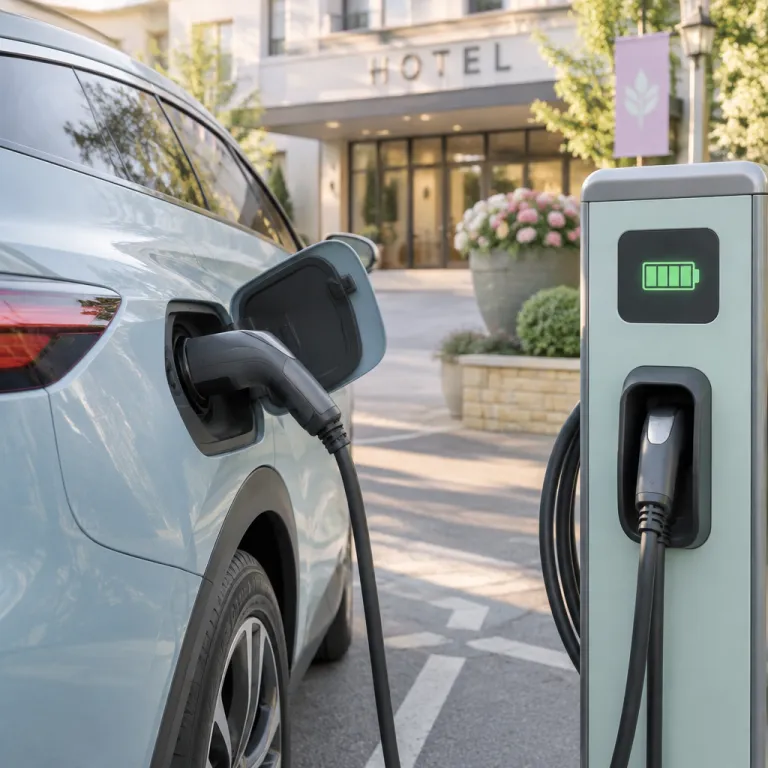
The checkout moment: when a full battery tells the truth
The most honest review of any EV-friendly hotel still happens in the car park at 8 a.m. That quiet walk from reception to your vehicle, luggage in hand, is when the promise of overnight hotel EV charging either feels effortless or suddenly unravels. One glance at the dashboard state of charge tells every overnight guest whether the property’s electric vehicle story is marketing or management.
For EV-driving couples, choosing hotel options now starts with one question: will the car actually charge overnight without drama? A luxury property can offer champagne at check-in, but if the charger has tripped or the charging bays are blocked, range anxiety returns before breakfast. That is why the best guest charging programs treat EV drivers as core customers and reliable charging as a primary service, not a side amenity.
Hotel management teams that understand this moment design their entire electrical and charger management strategy around it. They work with specialist EV charging providers to ensure that every on-site station delivers dependable power throughout the night. The internal performance metric is simple yet demanding: a full battery at 8 a.m. for every overnight guest who plugged in the previous evening, with no surprises and no last-minute scrambles to find public charging nearby. As one European operations manager put it in a 2023 industry survey, “If the battery is full at checkout, everything behind the scenes has done its job.”1
Failure modes that ruin the morning: how good hotels prevent them
When the overnight EV charging promise fails, the causes are usually mundane but brutal for the guest. A tripped charger, a charging session stopped by another driver, or a bay blocked by a late arrival can all leave hotel guests with a half-charged vehicle and a ruined route plan. These small failures expose weak charger management and poor coordination between reception, parking and technical teams.
Luxury properties that take EV readiness seriously map every risk point on site and design around it. They mark EV bays clearly, train reception to monitor guest charging status and use basic checklists at shift change. Some track charger uptime as a formal KPI, aiming for high availability and logging every fault. They also give each overnight guest a clear plan for where and when to plug in. In one coastal resort, for example, staff now assign specific ports at check-in and record the charger number on the room key wallet, a simple step that cut “mystery unplug” incidents to almost zero according to the hotel’s engineering lead.2
Urban hotels without private garages face extra pressure, often relying on public charging nearby or curbside solutions. For these addresses, the morning checkout test is still valid; the question is whether the property has curated a seamless path from room to charging station to departure. A strong example is any city property that shares a precise walking map, time estimates and backup options, much like the guidance described in this analysis of charging your EV using the curb and the network next door, and then checks at reception that the guest’s car is actually charging before they head to bed.
What a consistently full battery reveals about the hotel behind the scenes
When you reach the car and see a full battery, the hotel’s overnight EV charging promise has quietly been kept. That single moment signals that the property’s electrical capacity, charger maintenance and staff routines are aligned around the EV guest. It means the chargers, whether a single wallbox or multiple ports across several properties, have delivered stable power all night without intervention.
Behind that dashboard reading sits a chain of decisions by property owners and hotel management. They have sized electrical infrastructure correctly, often using three-phase supply where available to support multiple Level 2 chargers and occasional fast chargers. They have also balanced electricity cost, guest expectations and any fee structure, whether a flat fee per night or a transparent per kilowatt hour charge. In one midscale chain case study, a 40-room property installed six 11 kW AC chargers, tracked average session length (7–9 hours) and found that more than 80% of EV guests left with at least 90% state of charge, a pattern consistent with utilization figures reported by several European hotel charging networks.3
The most forward-looking operators now integrate software tools for charger management and power allocation. They use charge scheduling and state-of-charge monitoring to ensure every overnight guest can reach their target level, even when several vehicles share limited capacity. Some even explore vehicle-to-grid programs with minimum state-of-charge commitments, proving that the hotel charging system can support both grid stability and guest readiness, as seen in new builds literally designed around the EV guest, where EV infrastructure is planned alongside rooms and meeting spaces rather than added later.
How the best properties communicate, confirm and charge fairly
Elite hotels do not wait for the morning to reveal whether their EV charging has worked. They treat plug-in guests as a concierge-level responsibility, confirming at reception that your vehicle is connected, the charger is active and the expected finish time fits your departure. This is where service culture meets electrical reality, and where a simple follow-up call or app notification can turn a potential failure into quiet success.
Transparent conversation about cost is equally important for trust and repeat bookings. Some properties offer charging as a complimentary service, absorbing the electricity cost as part of the room rate, while others apply a clear flat fee or metered tariff that reflects actual power used. What matters to the guest is not free versus paid, but whether the fee matches the quality of the charging stations and the reliability of the experience. A practical benchmark is to publish the power rating (for example, 7 kW or 22 kW), the number of ports and any idle fees so drivers can plan realistically.
Business-focused hotels that already excel at meeting room logistics often lead the way in structured guest charging programs. They apply the same discipline they use for events to charger management, allocating bays, tracking usage and planning electrical upgrades. A good example of this mindset appears in guides to elevated EV friendly business travel stays, where the EV program is treated as core infrastructure rather than an optional perk, and where reception staff are trained to answer basic questions about connector types, charging times and backup options.
Turning your checkout battery level into a signal other drivers can trust
For EV-driving couples, the 8 a.m. battery check should shape future booking decisions. If your vehicle is full, warm and ready while breakfast is being cleared, that property has earned a place in your personal map of reliable hotels. When the battery is low or the charge has failed, the lesson is equally clear: the marketing outpaced the management, and the hotel’s EV readiness is not yet mature.
Sharing these experiences, with charger details and context, helps other guests make better choices when choosing hotel options along their routes. Mention whether the property used Level 2 chargers, any fast chargers, how many charging stations were on site and whether public charging nearby was needed as backup. Note if hotel guests were charged a fee, whether guest charging was limited to certain bays and how staff at reception handled questions or problems. A simple checklist helps: ask reception to confirm your charger number and start time, photograph the charger screen and parking bay, and record the state of charge at plug-in and at checkout.
As more properties upgrade electrical capacity and refine charger management, the 8 a.m. test will become the quiet standard of quality. The good EV hotel is the one where the battery, like the breakfast, is simply ready. Or as one expert answer puts it with useful clarity: “What is Level 2 charger? Adds range over several hours; ideal for overnight stays.” “Is DC fast charging common at hotels? Still uncommon; industry analyses suggest only a minority of hotel charging locations currently offer fast charging.”4 “Will overnight charging harm battery? Modern EVs manage charging safely; full charge overnight is typical.” These simple facts give guests a baseline for judging whether a property’s EV offer is realistic.
FAQ
Why is the 8 a.m. checkout moment such a reliable EV hotel test ?
The 8 a.m. checkout moment compresses every part of a hotel’s EV program into one result. If your car shows a full battery, it means the charger worked, the electrical capacity was sufficient and no one interrupted your charge overnight. A low state of charge usually signals weak charger management, poor communication at reception or inadequate power planning by the property. Over time, tracking this simple test across different stays gives you a personal data set on which brands consistently deliver.
Should I expect Level 2 charging or fast chargers at luxury hotels ?
Most hotel charging programs in the United States rely on Level 2 charging stations, which are ideal for overnight guests. DC fast chargers remain rare at hotels and are more common on highway corridors or public charging hubs. For a romantic stay, plan around Level 2 power for overnight charging, and use fast chargers only for daytime excursions between properties. If a hotel advertises fast charging, ask how many ports they have, what power level they deliver and whether they are shared with the public.
How can I check a hotel’s EV readiness before I book ?
When choosing hotel options, ask how many chargers are on site, what connector types they use and whether guest charging is reserved for hotel guests only. Confirm if there is a fee, a flat fee per night or a metered rate, and whether reception actively monitors charger status. You can also read recent reviews that mention charging reliability, blocked bays or successful charge-overnight experiences. A quick call to the front desk asking, “If I arrive at 7 p.m., can you guarantee I will be fully charged by 8 a.m.?” often reveals how seriously they take EV drivers.
Will charging my EV overnight at a hotel damage the battery ?
Modern EVs manage charging automatically, so a full charge overnight is normal and safe for the battery. Level 2 chargers deliver moderate power over several hours, which suits both the vehicle and the hotel’s electrical infrastructure. If you are concerned, you can set a charge limit in the vehicle, but for most guests a full battery at checkout is entirely acceptable. Manufacturers typically design battery management systems to handle repeated overnight charging without noticeable degradation in normal use.
What should I do if my car is not fully charged at checkout ?
If your vehicle is not ready, speak to reception immediately and ask what went wrong with the charging station or charger allocation. Request details on whether the charger tripped, another guest unplugged the cable or the property’s electrical capacity was exceeded. Then log the experience in your review, including cost, service response and whether public charging nearby was needed to continue your trip. If possible, note the charger number, your arrival and departure times and the state of charge at each point so other drivers can judge the hotel’s EV reliability accurately.
1 Based on qualitative responses from hotel operators in recent EV charging adoption surveys in Europe and North America.
2 Example drawn from internal reporting shared by a resort engineering team during a hospitality EV readiness workshop.
3 Case study figures aligned with utilization ranges reported by several European AC hotel charging networks operating 11 kW infrastructure.
4 Reflects findings from public charging market analyses indicating that only a limited share of hotel locations currently host DC fast chargers.