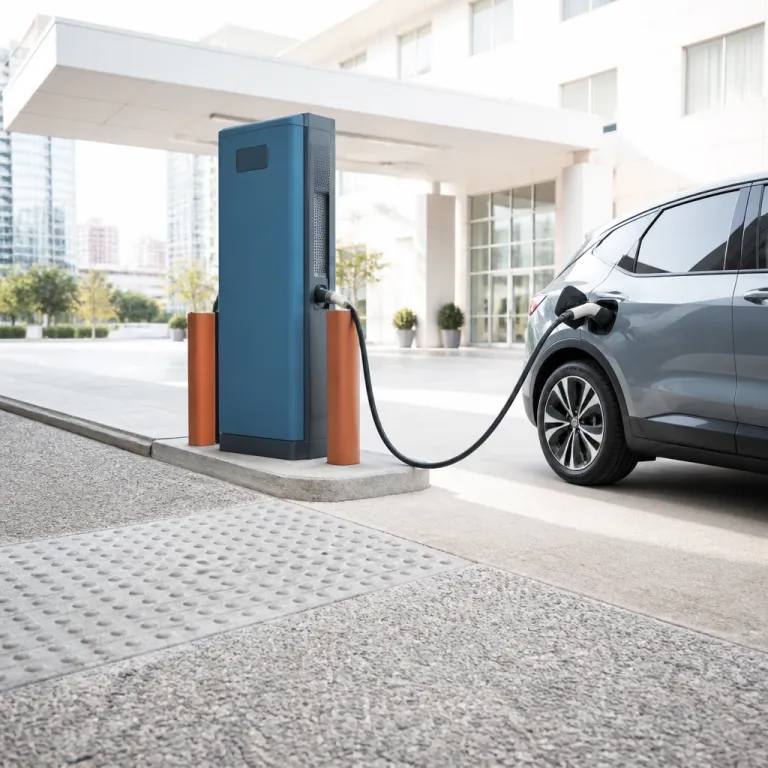
How DC fast reshapes the city hotel charging dynamic
Walk into a central city hotel today and the DC fast charger humming in the guest parking area can matter more than the skyline view. When a hospitality property moves from slow level chargers to high power DC fast charging stations, the entire DC fast charger city hotel guest experience shifts from quiet overnight refills to short, strategic top ups woven around meetings and dinners. For EV driving guests used to planning vehicle charging around long stays, that change feels radical yet instantly intuitive.
Traditional hotel charging meant arriving late, plugging into a level charger in the parking garage and hoping the electrical capacity was not shared with eight other electric vehicles. With a 150 kilowatt DC charger, many mid size EVs can add on the order of 150 to 200 miles of range in roughly thirty minutes, although real world results depend on the vehicle’s maximum DC acceptance rate, battery size and state of charge. For example, tests published by the U.S. Department of Energy’s Alternative Fuels Data Center and manufacturer data sheets for models such as the Hyundai IONIQ 5 and Tesla Model 3 show peak charge rates near 150 kW but lower average power over a full session as the battery fills. Fast chargers turn the hotel charging station into a high value stop for both overnight guests and day visitors who treat the hotel like a premium service hub. The result is that hotels charging no longer serve only sleeping guests; they become urban charging stations for business travelers, restaurant patrons and even fleet charging operators.
Management teams see the same hardware through a different lens, because a DC fast charger is not just another amenity like a spa or pool. It is a piece of charging infrastructure that demands serious energy planning, close support from the local utility and a clear strategy for pricing fast charging so that the power draw pays for itself. In Washington DC, for example, several early adopting hotels have integrated chargers with their booking systems so guests can reserve a station, check charging fees and align their stay with their electric vehicle range before they even arrive, a pattern echoed by properties in cities such as Oslo and Amsterdam that publish real time charger status alongside room availability. Case studies from operators like Marriott and Hilton, highlighted in industry reports by organizations such as the American Hotel & Lodging Association, show that this integration can increase both charger utilization and guest satisfaction scores.
From overnight refill to one hour ritual: new urban use cases
Once DC fast chargers appear in city hotels, the classic overnight charging pattern fragments into a series of shorter, more intentional sessions. Business guests now arrive in the afternoon, plug into a fast charging station for forty minutes, head to a meeting and return to an electric vehicle already topped up for the next leg. Restaurant guests and spa visitors treat the charger as a quiet companion to their evening, turning guest parking into a subtle choreography of vehicles, chargers and check in times.
This new rhythm creates a different kind of hospitality, where hotel charging becomes part of the welcome rather than a hidden utility in the basement. Front desk teams are trained to talk about charging solutions with the same fluency as room categories, explaining which station offers DC fast charging, which level chargers are better for overnight stays and how the hotel manages power across multiple charging stations. For guests wary of greenwashing, guides such as the hotel EV program reality check help them separate genuine charging infrastructure from marketing language about electric vehicles, and encourage them to look for clear pricing, visible hardware and published uptime statistics.
Short stay patterns also bring new users into hospitality properties that once catered only to checked in guests. Local drivers book a massage and a fast charging slot together, while corporate travelers schedule a pre flight top up at a city hotel that sits between the office and the airport, turning hotels resorts into urban mobility hubs. The DC fast charger city hotel guest experience becomes less about where you sleep and more about how seamlessly your vehicle charging fits around the rest of your life, from client lunches to evening events.
Revenue, pricing and the quiet business of kilowatt hours
Behind the polished lobby, DC fast chargers turn a hotel into a miniature energy business with its own economics. Commercial DC fast charging in cities often costs between fifty and eighty US cents per kilowatt hour, yet some charging hotels choose to absorb part of that cost to attract high value guests and corporate contracts. In regions with lower wholesale electricity prices or demand charges, typical tariffs can fall below that range, while in high cost markets they may exceed it, so travelers increasingly compare per kilowatt hour rates when choosing where to stay. Data from public networks such as Electrify America in the United States and Ionity in Europe, as summarized in annual pricing reviews by EV industry analysts, show urban fast charging prices clustering in this band, with notable variation by state, country and time of day. Others treat each charging station as a metered revenue stream, using payment systems that bill non guests at market rates while offering discounted hotel charging to loyalty members.
The shift from slow level chargers to fast chargers also changes how stations hotels think about utilization and guest experience. A level charger might serve one or two electric vehicles in a night, but a DC fast charger can handle a rolling queue of guests, restaurant visitors and even fleet charging vans across a single day. That throughput makes it easier to justify investments in electrical capacity upgrades, yet it also raises questions about fairness when eight cars arrive and only two plugs are free, a tension explored in depth in this analysis of what happens when hotel EV demand outpaces supply.
For hotel management, the most successful models treat vehicle charging as both amenity and profit center without letting either role dominate. Some hospitality properties offer a complimentary first hour of fast charging for every overnight guest, then charge a transparent per kilowatt hour rate beyond that, ensuring the station remains available and the power bill is covered. Others bundle charging solutions into premium room categories, positioning guaranteed access to a DC charger and reserved guest parking as part of a broader executive package that includes late checkout and lounge access.
Infrastructure, electrical capacity and the urban power puzzle
Installing a DC fast charger in a dense city hotel is less about finding space in the parking area and more about finding power in the grid. High power fast charging stations can draw hundreds of kilowatts, which means hospitality properties must work closely with utilities to assess electrical capacity, upgrade transformers and sometimes even reconfigure building level distribution. The process often involves new switchgear, dedicated metering for charging stations and careful planning so that elevators, kitchens and guest rooms never feel the impact of a simultaneous charging surge.
Forward thinking hotels charging in cities like London, Dubai and Los Angeles are approaching this as a long term infrastructure project rather than a quick sustainability badge. They map out where level chargers will serve overnight guests, where DC fast chargers will sit closest to entrances for short stay users and how vehicle charging will expand as electric vehicles move from niche to normal. Partnerships between hotel owners and specialist charger operators, including high power collaborations seen in parts of Germany and the Nordic countries, show how shared investment can turn a single charging station into a scalable network across multiple hotels resorts.
Operationally, the DC fast charger city hotel guest experience depends on more than cables and concrete. Staff need clear protocols for charger downtime, guest support when a station is occupied and contingency plans when a visiting fleet charging operator arrives with several vehicles at once. Smart software that manages charging infrastructure in real time, balancing power between chargers and prioritizing fast charging for departing guests, is becoming as critical to hospitality as a reliable property management system. Industry pilots with load management platforms in cities such as Stockholm and Vancouver, documented in utility program reports, demonstrate how dynamic power sharing can cut peak demand while keeping charge times acceptable for travelers.
Where DC fast hotel charging is changing stays first
Not every city is moving at the same pace, and that matters for EV travelers planning their routes. In Dubai, luxury hotels with generous parking footprints are adding DC fast chargers alongside level chargers, turning valet areas into discreet charging hubs for high end electric vehicles and visiting fleets. London shows a different pattern, where space constrained hotels charging along major arteries use a handful of fast chargers to attract transit guests who need a one hour top up between regional meetings.
Los Angeles and Washington DC illustrate how urban form shapes the DC fast charger city hotel guest experience in more subtle ways. In car centric Los Angeles, hotels resorts near freeways market their charging stations as an alternative to crowded public sites, promising reliable fast charging and secure guest parking while you sleep or dine. In Washington DC, several early adopting properties have integrated chargers with their booking engines so guests can confirm charger availability, bring their own cable if required and align their overnight stay with a planned morning departure, a model that is increasingly common in North American and European business districts.
For travelers who care as much about a smooth vehicle charging stop as a refined suite, curated guides such as the review of refined comfort at RR Hotel Reykjavík on EV friendly premium suites point toward a new standard. The best charging hotels are not the ones with the loudest sustainability claims, but the ones where the charger is exactly where you need it, the power is reliable and the hospitality team treats your electric vehicle as part of the guest experience rather than an afterthought. As one industry FAQ puts it with disarming clarity, “Do hotels charge for EV charging? Some do; policies vary. Are hotel EV chargers universal? Most support common connectors. How long to charge at hotel? Depends on charger type; DC fast chargers are quicker.”
FAQ
Do city hotels usually charge a fee for DC fast charging ?
Many city hotels apply a separate fee for DC fast charging because the power draw and energy cost are significantly higher than for level chargers. Some properties offer complimentary or discounted hotel charging for overnight guests while billing non guests at standard commercial rates. Policies vary widely, and in some regions local regulations affect whether hotels may bill per kilowatt hour or per minute, so it is wise to check the charging station pricing when you book.
How long should I plan to stay while using a DC fast charger at a hotel ?
A modern DC fast charger at a city hotel can often add substantial range in thirty to sixty minutes, which aligns well with a meal, a spa visit or a short meeting. Unlike traditional overnight charging on level chargers, you rarely need to leave the vehicle plugged in for many hours. The exact duration depends on your electric vehicle, the charger power level, the charging curve of your battery and how full your battery is when you arrive.
Are hotel EV charging stations compatible with all electric vehicles ?
Most hotel charging stations are designed to support the dominant fast charging and level charging connectors used by electric vehicles in their region, such as CCS, CHAdeMO or Type 2. However, compatibility can vary, especially for older vehicles or certain imported models. Checking connector types and any adapter requirements before arrival helps avoid surprises at the charging station.
Can non guests use DC fast chargers at city hotels ?
Many urban hospitality properties open their DC fast chargers to non guests, especially when the stations are located in easily accessed parking areas. These users typically pay standard per kilowatt hour rates and may have time limits so that overnight guests retain access. Some hotels also partner with charging networks, allowing day visitors to activate the charger with their usual charging app or RFID card.
What should I check before booking a hotel for EV charging ?
Before booking, confirm whether the hotel offers DC fast charging, level chargers or both, and whether chargers are located in secure guest parking or a shared public lot. It is also useful to ask about reservation options for the charging station, any fees, whether idle charges apply once your session ends, and whether you need to bring your own cable. These details can transform your DC fast charger city hotel guest experience from anxious range management into a smooth, predictable part of your trip.