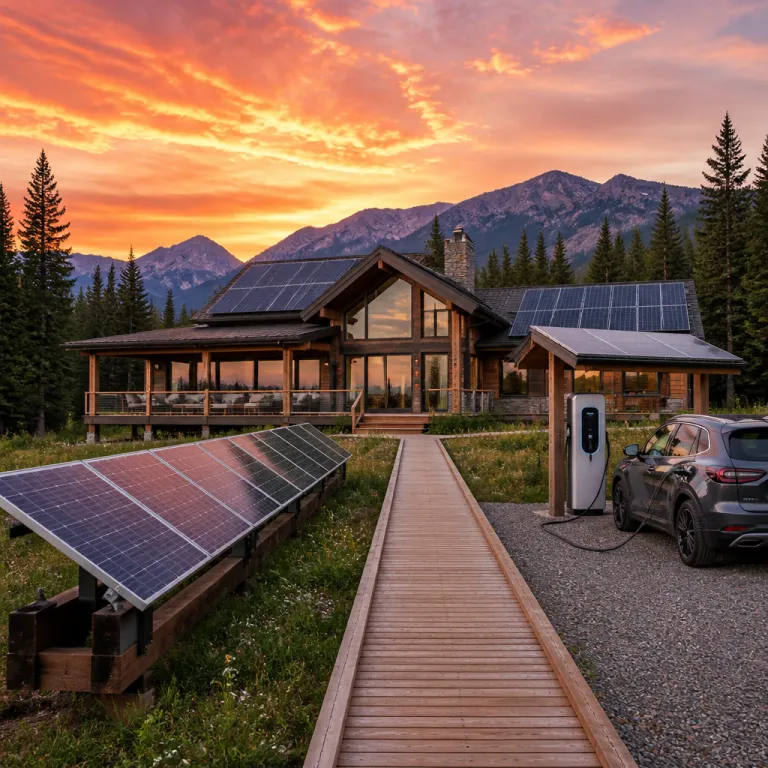
Why off-grid wilderness lodge EV solar charging is changing the luxury map
Remote luxury once meant diesel generators humming behind the staff quarters. Today, off-grid wilderness lodge EV solar charging lets high-end properties in remote areas run quietly on solar power and battery storage while still topping up your electric vehicle overnight. For EV drivers, that shift turns previously unreachable wilderness into a confident, range-anxiety-free part of the travel landscape.
At its core, an off-grid wilderness lodge EV solar charging setup replaces a traditional grid connection with a dedicated photovoltaic system, a lithium battery bank, and smart load management that treats every kilowatt-hour as precious. Solar panels feed a solar array that charges a battery storage cluster during high-light hours, then the energy storage system releases electricity to suites, kitchens, and electric vehicle chargers after dark. When the design is done well, guests barely notice the engineering; they just see a charger by the trailhead and a room where the heat, lighting, and hot water feel effortless.
Operators such as Esiweni Luxury Safari Lodge in South Africa or Kodiak Raspberry Island Remote Lodge in Alaska publicly describe running primarily on on-site renewable energy and advanced power system controls in their own sustainability communications. These properties, along with other documented solar-based microgrids in the hospitality sector, demonstrate that well-designed systems can support both gourmet kitchens and Level 2 chargers for electric vehicles while sharply reducing dependence on the public power grid. For EV travelers, that means you can plan multi-day stays in remote areas where the nearest utility line might be many kilometers away, yet your electric car and your suite remain fully powered.
How the solar energy system behind your wilderness EV charge actually works
Behind the scenes, every off-grid wilderness lodge EV solar charging installation starts with a carefully sized solar array. Engineers calculate the expected energy use of suites, kitchens, heat pumps, water pump systems, and electric vehicle chargers, then translate that into required kilowatt-hours of solar generation and battery capacity for cloudy days. The result is a solar-powered microgrid that behaves like a private power network, only without the poles and wires.
On a clear day, solar panels convert sunlight into electricity, which first covers live loads such as air conditioning, heat, and kitchen equipment. Any surplus flows into a storage battery bank, often built from modular battery products rated in kilowatt-hours that can be expanded as the lodge adds more electric vehicles or guest rooms over the years. When the sun sets, the battery system takes over, feeding a stable flow of electricity to guest suites and to slower 7 to 11 kW chargers that are ideal for overnight charging without stressing the overall load.
Smart controls constantly watch the total load so the system will never overcommit power during peak times. If several guests plug in electric cars at once, the software can temporarily reduce power to non-essential circuits, keeping the EV chargers running while the kitchen still has enough electricity to plate dinner perfectly. One lodge manager describes it as “a quiet choreography between the stoves, the suites, and the cars.” For a deeper look at how great hotels integrate chargers into the arrival experience, the analysis of where great hotels make the charger disappear shows how design and power planning now go hand in hand.
From fjords to Montana ranches: where off-grid EV lodges already shine
Some of the most compelling off-grid wilderness lodge EV solar charging projects sit at the end of roads that used to belong only to diesel trucks. In the Scandinavian fjords, small waterfront lodges pair solar panels with compact battery banks so guests can arrive by electric vehicle and still charge while watching the midnight sun. In the Scottish Highlands and parts of Iceland, similar solar microgrids support both the lodge and a handful of EV chargers, turning once marginal roads into viable touring routes for electric cars.
Farther afield, Clayoquot Wilderness Lodge on Vancouver Island and Pel’s Post in South Africa publicly highlight their use of renewable energy, battery storage, and careful load management to support high-end tents, gourmet kitchens, and guided activities with minimal reliance on the power grid. A typical specification for this kind of site might include a 40 to 80 kW solar array, 200 to 400 kWh of lithium battery storage, and several 7 kW AC chargers for guests’ vehicles, with conservative assumptions for winter output and battery depth-of-discharge. In North America, Montana ranch-style properties and Alaska’s Kodiak Raspberry Island Remote Lodge use a mix of solar energy, storage capacity, and sometimes backup generators to handle winter heat loads while still offering reliable overnight charging for electric vehicles. These remote areas prove that when the solar system and power system are sized correctly, guests never need to think about kilowatt-hours or load balancing; they simply plug in and sleep.
Architects now treat the charger as part of the landscape, not an afterthought in the parking lot. At some lodges, the EV point sits beside a timber-framed arrival pavilion where the same solar array that feeds the suites also powers the charger canopy. One guest at a Scandinavian property described the experience as “plugging in under the pines while the fjord turned pink at sunset.” For design-focused travelers, the case studies in EV hotels where design meets function show how a well-integrated solar layout can make the charger feel as natural as the firepit.
The guest experience: slow kW, long days, and deep quiet
Life at an off-grid wilderness lodge EV solar charging retreat moves at a different pace from a highway fast charge stop. Most properties offer 7 to 11 kW Level 2 chargers, which means your electric vehicle adds range steadily over several hours instead of in a quick burst. That slower charging rhythm matches the lodge experience; you arrive, hand over the keys, and let the staff take care of both your battery and your bags while you settle in.
Because the entire energy system is carefully balanced, staff may schedule charging windows so the total load stays within what the solar array and battery bank can comfortably support. You might plug in after the afternoon game drive, then wake to a fully charged battery in your car and a room that stayed perfectly warm thanks to efficient heat pumps and a well-insulated shell. Guests rarely see the numbers on the internal electricity bill, but they feel the benefits in the form of silent nights, clean air, and a suite where the heat, lighting, and hot water simply work.
Daily life revolves around long days outdoors rather than rushing back to the road. Morning might bring a guided hike, a fjord kayak, or a safari drive, while the solar panels quietly refill the storage battery behind the scenes. By the time you return for dinner, the power system has shifted from daytime solar production to evening battery discharge, and your electric vehicles are ready for whatever the next leg of the journey will require.
Planning your trip: how to route an EV to an off-grid lodge
Routing an electric vehicle to an off-grid wilderness lodge EV solar charging property requires a slightly different mindset from a standard highway trip. You plan your last fast charge near the main grid power corridor, then treat the final stretch into remote areas as a one-way leg with a guaranteed overnight top-up at the lodge. That approach keeps your battery in a comfortable state of charge and avoids stressing the lodge’s solar system on arrival.
Before you book, confirm exactly what type of electric chargers the property offers, how many ports exist, and whether you need to reserve a charging slot on specific days. Some lodges run entirely on solar energy and battery storage, while others keep a small generator or a backup connection to the power grid for rare periods of extended cloud cover. Either way, a clear conversation about load management, expected charging speeds, and any limits on simultaneous electric vehicles will help you avoid surprises.
Pack your own cables and adapters, because off-grid sites may not stock every regional plug standard or every brand-specific set of products. Arrive with a warm battery, not one that has sat for hours in extreme cold, so the heat pump and onboard systems in your car can accept charge efficiently. Above all, don’t treat the lodge like a highway service station; respect that their solar-powered microgrid is carefully tuned, and your patience will be rewarded with both a full car and a rare sense of quiet luxury.
Inside the tech: from heat pumps to smart meters and future proof design
The technology stack behind off-grid wilderness lodge EV solar charging is more sophisticated than many city hotels connected to a robust power grid. High-efficiency heat pumps handle both space heat and cooling, reducing the total kilowatt-hour load that the solar array and battery bank must support. Water pump systems are often variable speed, drawing only as much electricity as needed to keep taps flowing and showers hot.
Smart meters and building management software track every major load in real time, from kitchen equipment to EV chargers, so the system will automatically shed non-essential circuits if clouds roll in and solar power drops. Over time, operators learn which days of the week and which seasons bring the heaviest demand, then adjust their solar panels, storage capacity, and even guest policies accordingly. Some properties experiment with DC-coupled solar designs that reduce conversion losses and keep more usable energy in the battery bank for both suites and electric vehicles.
Forward-looking lodges also think carefully about future electric vehicle adoption and the possibility of higher power system demands. They may pre-install conduit for extra chargers, oversize the inverters, or choose modular battery products that can be expanded as more guests arrive in EVs. As a simplified example, a site expecting 150 kWh of daily use might install a 60 kW inverter and 300 to 400 kWh of storage, then operate the batteries between roughly 20% and 80% state of charge to preserve lifespan and maintain a buffer for edge cases such as several cloudy days or cold-weather performance dips. As one operator explains to guests, “Modern comforts like en-suite bathrooms, gourmet dining, and guided activities are now entirely compatible with a fully solar-powered, off-the-grid stay.”
Key figures: numbers behind off-grid solar powered EV lodges
- A fully off-grid lodge such as Esiweni Luxury Safari Lodge reports operating on 100% on-site renewable energy for core services during much of the year, showing that a well-designed solar system can in practice replace grid power for both suites and EV charging in favorable conditions.
- A private conservancy of 10,000 hectares, like the one managed by Kuganha Luxury Tented Lodge, offers vast remote areas where extending the power grid would be prohibitively expensive, making solar panels and battery storage the only practical way to support electric vehicles.
- Clayoquot Wilderness Lodge operates with just 25 tents, illustrating how small-scale properties can still justify investment in solar power and a battery bank when nightly rates sit in the USD 300 to 800 range and EV charging is part of the value proposition.
- Industry data on hotel charging shows that a 10 kW solar array operating for five peak-sun hours can generate roughly 50 kWh of electricity per clear summer day, enough to fully recharge many mid-size EVs while still supporting part of the lodge’s internal load.
- Premium eco lodges typically price rooms between USD 300 and 800 per night, and including EV charging in that rate effectively shields guests from any separate charging bill while helping the property manage its overall power system more predictably.
FAQ: off-grid luxury lodges and EV solar charging
What amenities can I expect at an off-grid wilderness EV lodge?
Most off-grid wilderness lodge EV solar charging properties offer the same core comforts as city luxury hotels, including en-suite bathrooms, high-quality bedding, and refined dining. Many also include guided activities such as game drives, hiking, or kayaking tailored to their specific landscapes. The main difference is that all of this runs on solar energy and battery storage instead of a conventional power grid connection.
How reliable is EV charging at an off-grid solar powered lodge?
When the solar system and battery bank are properly sized, EV charging is highly reliable, especially for overnight stays. Lodges typically use Level 2 chargers in the 7 to 11 kW range, which place a manageable load on the microgrid while still filling most electric vehicles by morning. Some properties keep a backup generator or limited grid power link for rare periods of extended bad weather or unusual demand.
Are off-grid luxury lodges suitable for families traveling by electric vehicle?
Yes, many off-grid wilderness lodge EV solar charging properties are family friendly and offer multi-room suites or tents. Activities such as wildlife viewing, gentle hikes, and water-based excursions work well for mixed age groups. Parents simply need to coordinate charging times with staff so the lodge can balance total electricity use across all guests.
Do I pay extra for EV charging at these remote lodges?
Pricing policies vary, but many premium eco lodges fold EV charging into the nightly rate rather than issuing a separate bill. This approach simplifies operations and reflects the fact that solar power and battery storage are already core parts of the property’s infrastructure. Always confirm in advance whether charging is complimentary or metered per kilowatt-hour.
How should I prepare my EV before driving into remote off-grid areas?
Plan a full charge at the last fast charging point on the main power grid before turning toward the lodge. Check that your cables, adapters, and preconditioning settings are all working well, especially in very hot or cold weather. Share your estimated arrival time with the lodge so they can manage their solar array, storage battery, and overall load to welcome both you and your electric vehicle smoothly.